


Geotechnical Monitoring Is Evolving: From Instruments to Intelligent Decision Systems
Why Emerging Technologies Are Changing the Way We Manage Risk
In geotechnical engineering, monitoring has always been about one thing: reducing uncertainty.
Whether it’s a tailings dam, slope stability, or critical infrastructure, decisions are only as good as the data behind them. But the way that data is collected, transmitted, and interpreted is undergoing a fundamental shift.
What was once periodic, manual, and reactive is rapidly becoming continuous, connected, and intelligent.
The result?
Geotechnical monitoring is no longer just about instruments—it’s about decision systems powered by reliable, real-time data.
From Manual Readings to Continuous Visibility
Traditionally, geotechnical instrumentation relied heavily on manual readings:
- Site visits
- Data downloads
- Delayed interpretation
This approach created unavoidable gaps:
- Time delays between measurement and action
- Increased operational risk
- Higher dependence on human intervention
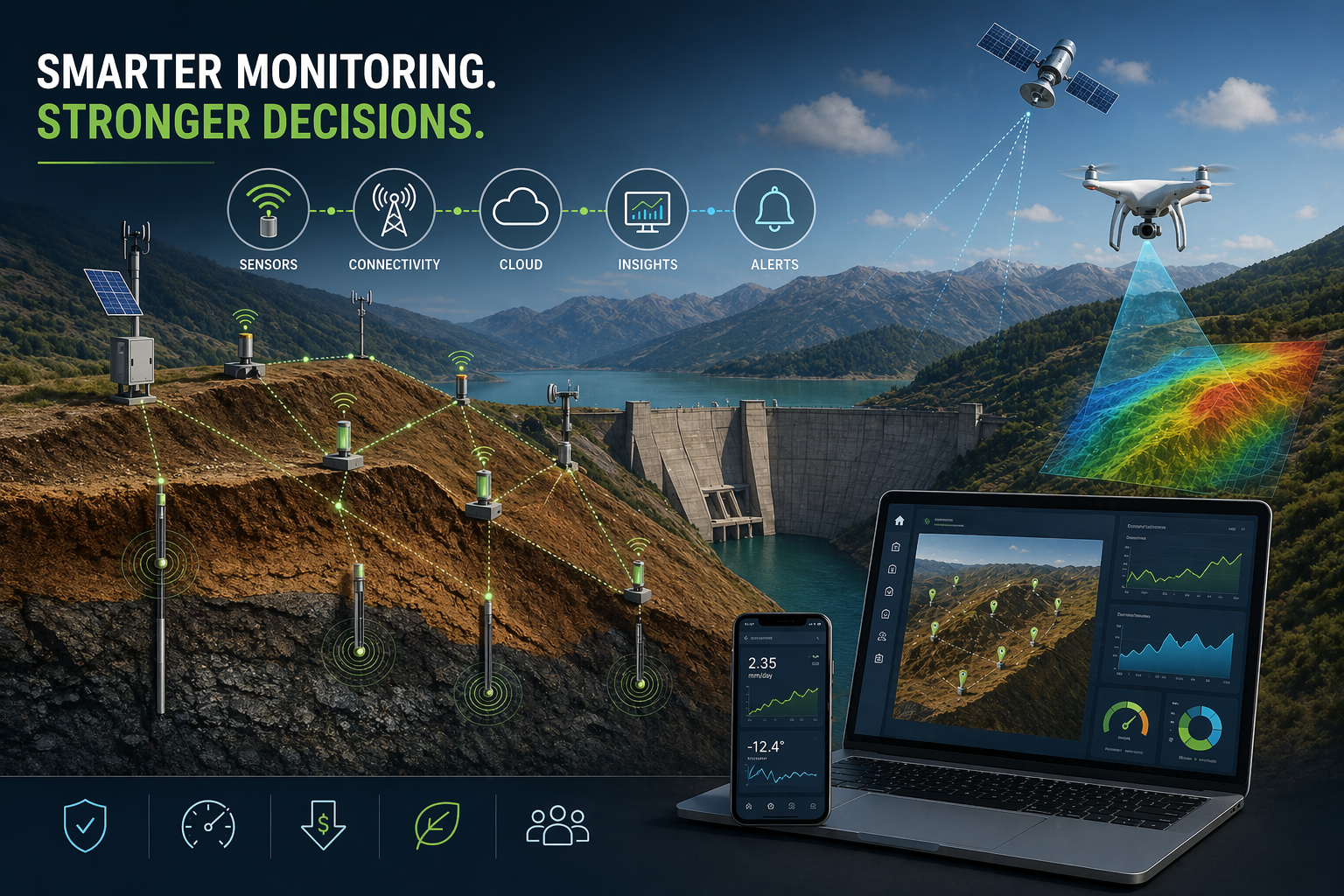
Today, that model is being replaced by always-on monitoring ecosystems—where data flows continuously and decisions can be made in real time.
Wireless Sensor Networks: Removing the Cable Constraint
One of the most impactful developments is the rise of wireless sensor networks (WSNs).
Instead of complex and vulnerable cabling infrastructure, sensors can now communicate wirelessly across a site.
Key advantages:
- Faster deployment in remote or hazardous locations
- Reduced installation and maintenance costs
- Flexible, scalable monitoring systems
For large or dynamic sites, this shift alone can significantly improve both coverage and reliability.
IoT and Cloud Integration: Data Without Borders
Modern monitoring systems are increasingly built on IoT-enabled platforms.
Sensors no longer store data locally—they transmit it directly to cloud-based systems, where it becomes instantly accessible.
What this enables:
- Real-time dashboards accessible from anywhere
- Centralized monitoring across multiple sites
- Faster response to emerging risks
This is a critical shift:
Data is no longer trapped in the field—it becomes part of a live operational picture.
Automation: From Reactive to Proactive Monitoring
Automation is transforming how data is collected and used.
Instead of relying on scheduled readings, systems now:
- Capture data at high frequency
- Trigger alerts when thresholds are exceeded
- Highlight trends before they become failures
The impact:
Monitoring moves from:
- “What happened?”
to - “What is happening—and what’s about to happen?”
This is where monitoring starts to deliver real operational value.
AI and Data Analytics: Making Sense of Complexity
As datasets grow, interpreting them manually becomes impractical.
Emerging analytics tools are beginning to:
- Identify patterns in long-term data
- Filter noise from meaningful signals
- Support predictive assessments of risk
While still evolving, this direction is clear:
The future of monitoring is not just collecting data—it’s understanding it at scale.
Remote Sensing and Drones: Expanding the Field of View
Point sensors remain critical—but they are no longer the only source of insight.
Technologies such as:
- UAV (drone) surveys
- LiDAR mapping
- Satellite-based deformation monitoring (InSAR)
are adding a spatial dimension to monitoring.
Why this matters:
- Large areas can be assessed quickly
- Risk exposure to personnel is reduced
- Surface changes can be correlated with instrument data
This combination of point data + spatial data provides a far more complete understanding of site conditions.
Low-Power Systems: Enabling Long-Term Monitoring
Behind the scenes, advances in power efficiency are enabling:
- Long-life battery systems
- Solar-powered installations
- Low-energy communication technologies
This makes continuous monitoring viable in:
- Remote mining operations
- Environmental monitoring sites
- Infrastructure with limited access
Reliability is no longer just about sensors—it’s about keeping systems running without interruption.
The Bigger Picture: Integrated Monitoring Ecosystems
What ties all of these developments together is integration.
Modern geotechnical monitoring systems are no longer isolated components. They are connected ecosystems combining:
- Sensors
- Telemetry
- Cloud platforms
- Analytics
This integration transforms monitoring from a technical function into a decision-support system.
What This Means for Operators and Engineers
These emerging technologies are not just incremental improvements—they represent a shift in expectations.
1. Real-Time Data Is Becoming Standard
Delayed data means delayed decisions—and increased risk.
2. Data Quality Matters More Than Ever
More data is only valuable if it is:
- Reliable
- Accurate
- Contextual
3. Integration Is the True Differentiator
The real value lies not in individual instruments, but in how well the entire system works together.
4. Monitoring Is Moving Toward Prediction
The goal is no longer just to observe—it is to anticipate and act early.
Conclusion: From Measurement to Decision Intelligence
Geotechnical monitoring is evolving beyond instrumentation.
It is becoming a discipline centered on:
- Continuous visibility
- Connected systems
- Actionable insights
In this new landscape, success is defined not by how much data you collect—but by how effectively you use it.
Because in the end, monitoring isn’t about instruments.
It’s about making better decisions—earlier, with confidence.