


Can You Extend Ammonium ISE Sensor Calibration Beyond Four Weeks?
Accurate ammonium monitoring is essential for wastewater treatment, environmental compliance and understanding treatment process performance. As regulatory requirements become more stringent, utilities are under increasing pressure to deliver reliable water quality data while controlling operational costs.
One of the most significant contributors to those costs is routine sensor maintenance. Ammonium ion-selective electrode (ISE) sensors are commonly recalibrated every four weeks to minimise measurement drift and maintain confidence in the data. Every calibration requires field visits, skilled personnel, calibration standards and equipment downtime.
But is a four-week calibration interval always necessary?
A recent In-Situ field study explored this question by evaluating the performance of ammonium ISE sensors over calibration intervals ranging from four to twelve weeks under real-world monitoring conditions. The results suggest that, for this particular site, longer calibration intervals may be achievable without compromising the ability to detect meaningful changes in water quality.
Why Ammonium Monitoring Matters
Ammonium is one of the most important indicators of wastewater treatment performance. Elevated concentrations may indicate process inefficiencies, combined sewer overflow (CSO) events, untreated discharges or pollution entering receiving waters.
The study was undertaken in the United Kingdom, where increasing regulatory requirements for CSO monitoring, including those introduced under Section 82 of the Environment Act 2021, have driven the need for reliable continuous water quality monitoring. While the legislation is UK-specific, the operational challenges of maintaining accurate long-term monitoring systems are shared by utilities worldwide.
The Cost of Frequent Calibration
Routine calibration ensures sensor accuracy, but it also introduces recurring operational costs.
For many utilities, regular calibration means:
- Scheduled site visits
- Skilled technicians
- Calibration solutions and laboratory support
- Temporary interruption of monitoring
- Increased maintenance expenditure across multiple monitoring locations
As monitoring networks continue to grow, reducing unnecessary maintenance without sacrificing data quality becomes increasingly valuable.
The 12-Week Field Trial
To investigate whether calibration intervals could be safely extended, In-Situ deployed four identical ammonium ISE sensors on a single Aqua TROLL® 800 Multiparameter Sonde.
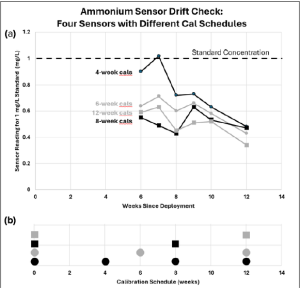
Each sensor followed a different calibration schedule:
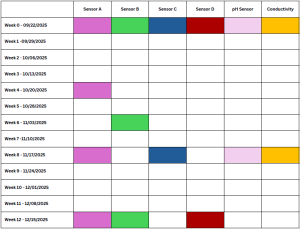
Installing all four sensors on the same sonde ensured they continuously measured the same water sample, making calibration interval the only meaningful experimental variable.
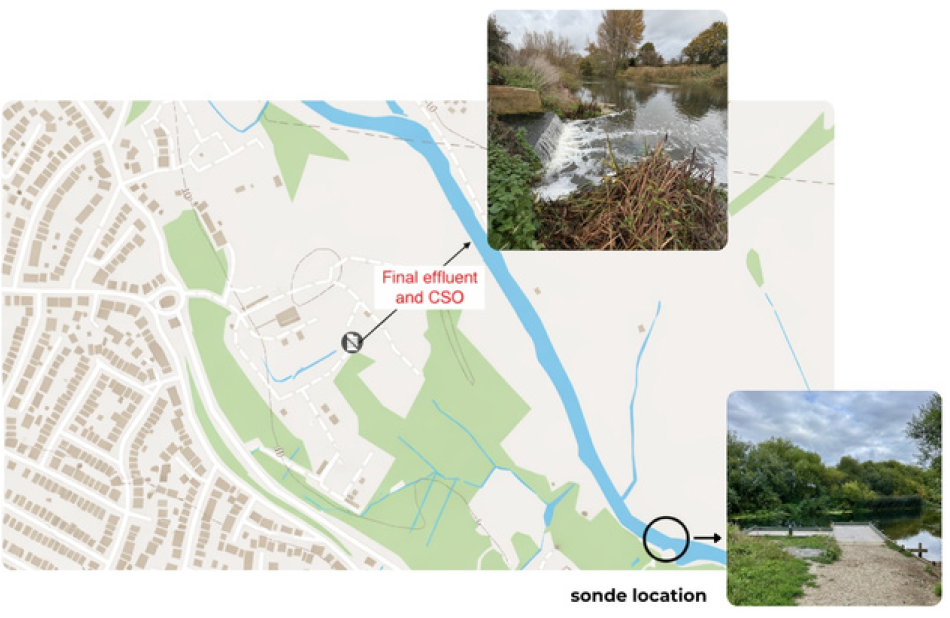
The monitoring station was located approximately 100 metres downstream of a treated effluent outfall that also functioned as a permitted combined sewer overflow. The sonde collected readings every 15 minutes between 22 September and 15 December 2025, with data downloaded during weekly site visits using the VuSitu™ mobile application.
Automatic Cleaning Played a Key Role
An important aspect of the trial was the Aqua TROLL 800’s integrated mechanical wiper.
Throughout the entire 12-week deployment:
- the wiper operated automatically every 15 minutes,
- no wiper maintenance was performed,
- no wiper replacement was required,
- no routine cleaning of the deployed sensors took place between scheduled calibration events.
The authors note that this automatic cleaning was likely a significant factor in maintaining sensor stability over the extended deployment. They also caution that similar performance may not be achieved under the same calibration intervals without an effective automatic cleaning system.
What Did the Study Find?
The results were remarkably consistent.
Although each sensor followed a different calibration schedule, all four exhibited very similar behaviour throughout the deployment.
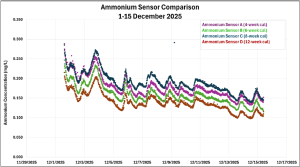
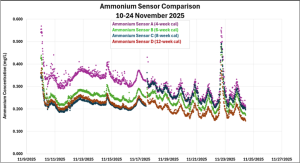
Typical ammonium concentrations at the site ranged between approximately 0.2 and 0.4 mg/L, with all four sensors responding similarly to both routine conditions and rainfall-driven events. Even after twelve weeks, the sensor that had not been recalibrated remained within approximately 0.1 mg/L of the other three sensors during both field measurements and standard checks.
Perhaps more importantly, every sensor successfully detected short-term increases in ammonium concentration associated with precipitation events, demonstrating that extending calibration intervals did not prevent the monitoring system from capturing significant changes in water quality at this site.
Understanding the Weekly Standard Measurements
Beginning in week six, the researchers performed weekly checks using a fresh 1 mg/L ammonium standard solution.
All four sensors consistently measured below the standard concentration by approximately 0.4 mg/L, indicating a systematic negative offset rather than random sensor drift. Despite this offset, the readings remained within the manufacturer’s published accuracy specification of ±10% or ±2 mg/L (whichever is greater). More importantly, all four sensors remained in close agreement with one another throughout the study, reinforcing confidence in their ability to track changes and trends consistently.
One scheduled standard measurement was missed during week eleven because flooding prevented access to the monitoring site, highlighting one of the practical realities of long-term field deployments.
An Important Experimental Detail
Although the study reports that no routine maintenance was performed during the deployment, the sensors were not completely untouched.
During weekly data collection and standard measurements, the sonde was removed from the stilling tube and rinsed with clean water using a pressurised spray bottle before the standard solution was applied. The authors acknowledge that this weekly rinsing likely removed some debris from the sensor faces and therefore may have contributed to the excellent long-term performance observed.
As a result, fully unattended deployments without periodic inspection may experience different fouling behaviour depending on site conditions.
What Does This Mean for Wastewater Operators?
The findings suggest that longer calibration intervals may be practical for some monitoring programmes, particularly where automatic sensor cleaning and favourable site conditions help minimise fouling.
Potential benefits include:
- Reduced maintenance visits
- Lower operating costs
- Less instrument downtime
- Improved utilisation of field personnel
- More efficient long-term monitoring programmes
However, the authors are equally clear that these findings should not be generalised.
Calibration frequency remains highly site-specific and depends on factors such as water chemistry, sediment loading, biological fouling and operational requirements. Continuous ammonium monitoring using ISE sensors should also complement, rather than replace, laboratory analysis and grab sampling where required for compliance.
How SME Monitoring Can Help
SME Monitoring supplies advanced water quality monitoring solutions for wastewater treatment plants, environmental monitoring programmes, industrial facilities and municipal infrastructure throughout Southern Africa.
As an authorised distributor of In-Situ instrumentation, we provide:
- Aqua TROLL® Multiparameter Sondes
- Ammonium ISE Sensors
- HydroVu™ cloud monitoring
- Remote telemetry solutions
- Installation, commissioning and training
- Ongoing technical support
Whether you are expanding an existing monitoring network or investigating opportunities to reduce maintenance costs, our team can help you design a monitoring solution tailored to your site conditions.
Conclusion
This 12-week field study demonstrates that extended ammonium ISE sensor calibration intervals may be achievable under the right conditions.
Using four identical sensors installed on a single Aqua TROLL 800 Multiparameter Sonde, researchers found that calibration intervals of six, eight and even twelve weeks produced results comparable to the traditional four-week schedule at the monitoring site studied. Automatic sensor cleaning, consistent site conditions and periodic field checks all contributed to the successful deployment.
While every monitoring location should establish maintenance schedules based on its own operational requirements, the study provides encouraging evidence that longer calibration intervals may reduce maintenance costs without compromising the quality of trend data or the ability to detect important water quality events.