


Continuous Trade Waste Monitoring: Lessons from the SA Water and Kallipr Study
Trade waste monitoring is a challenge for wastewater utilities because industrial and commercial discharges can change significantly throughout the day.
A scheduled audit or grab sample provides valuable information, but it only represents conditions at a particular point in time. Production cycles, cleaning processes, changes in operating conditions and equipment faults can all affect what enters a wastewater network.
A recent SA Water and Kallipr trade waste monitoring study demonstrates how continuous telemetry can provide utilities with a much clearer picture of these changing conditions.
The project moved trade waste monitoring from a largely periodic and manual process towards near real-time remote monitoring, connecting existing monitoring equipment to a central data platform.
For utilities managing large numbers of trade waste customers, the approach provides an interesting example of how continuous monitoring can improve visibility, compliance management and operational response.
The Challenge with Traditional Trade Waste Monitoring
Trade waste can contain a wide range of substances depending on the industry and processes involved.
These can include:
- Fats, oils and grease
- Suspended solids
- Nitrogen compounds
- Metals
- Hydrocarbons
- High-strength organic material
The characteristics of a discharge can also change rapidly.
A manufacturing facility may have different discharge characteristics during production compared with cleaning operations. An unexpected equipment failure can also result in a discharge that looks very different from normal operating conditions.
This creates a problem for periodic monitoring.
A sample taken at 10:00 may show perfectly acceptable conditions, while an abnormal discharge could occur later in the day and return to normal before the next scheduled inspection.
The SA Water case study describes this limitation directly, noting that the historical approach was largely point-in-time, labour-intensive and manual. Monitoring information could also be distributed across customer-owned systems, making it more difficult for the utility to independently access and validate the data in real time.
The SA Water and Kallipr Trade Waste Monitoring Study
The SA Water and Kallipr project was developed to address this visibility gap.
SA Water authorises and regulates trade waste discharges under South Australia’s regulatory framework. The utility needed a more effective way of understanding the quality and quantity of discharges from major trade waste customers without relying solely on periodic sampling, customer reporting and site inspections.
The study investigated the use of connected monitoring technology to collect information continuously and make that data available remotely.
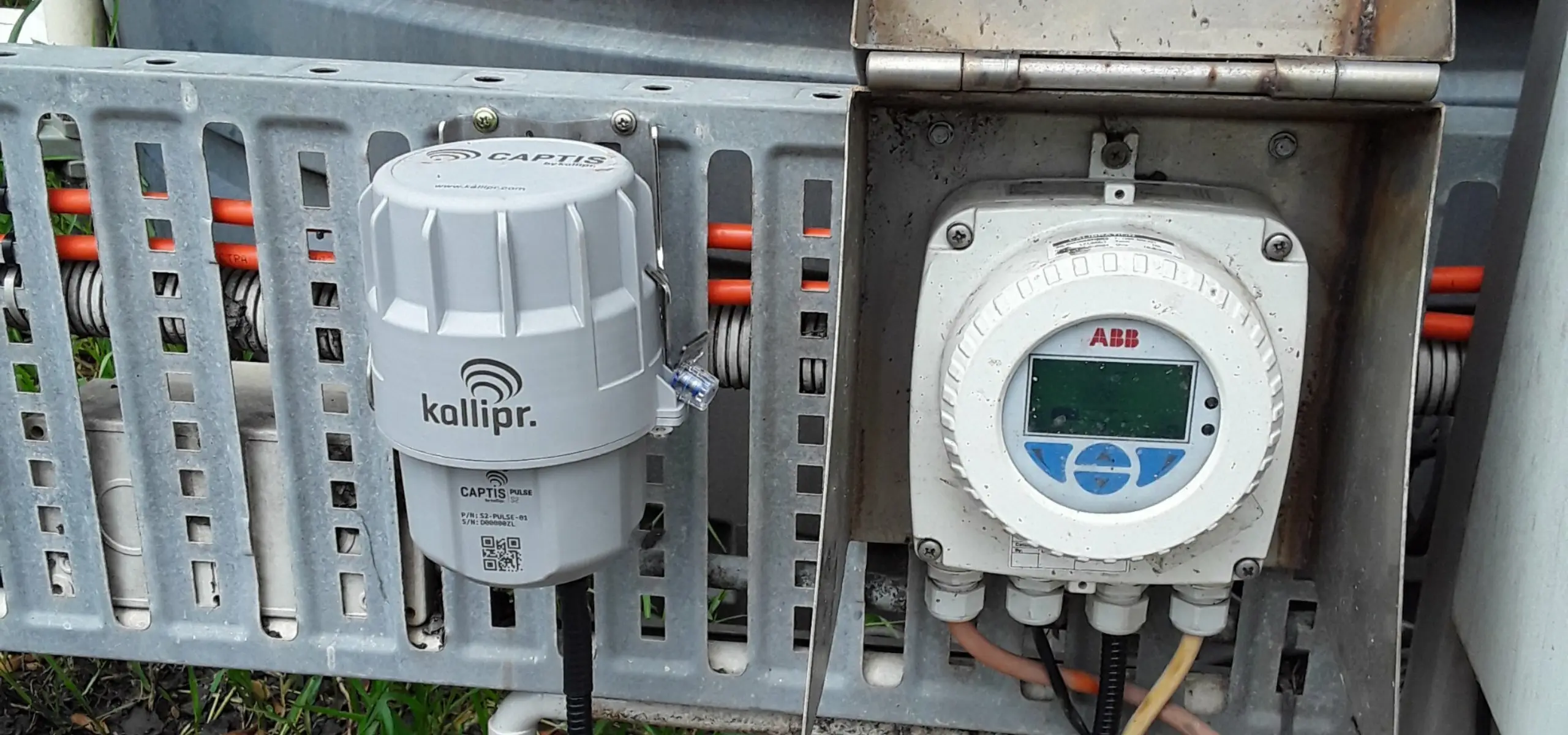
Rather than treating each monitoring installation as an isolated system, the approach connected existing trade waste equipment to a telemetry network.
This allowed measurements from different sites to be brought together into a central platform.
The distinction is important.
The objective was not simply to install more sensors. It was to create a system in which the data generated by those sensors could be accessed, monitored and acted upon remotely.
Connecting Existing Trade Waste Equipment
One of the practical aspects of the SA Water project is the use of telemetry to connect existing monitoring equipment.
According to the case study, the Kallipr Captis Recharge device can support multi-sensor applications, allowing information such as flow rates, water quality measurements and system health data to be collected from a monitoring site.
The Captis S2 is also being used across the network.
This type of architecture allows utilities to build monitoring systems around the measurement equipment already required at a site, while adding the communications and data-management layer needed for remote monitoring.
For large networks, that can be an important consideration.
A successful monitoring strategy needs to work not only at one site, but across many different customers, instruments and operating environments.
From Isolated Measurements to Centralised Data
Collecting measurements is only part of the solution.
The SA Water project uses Kallipr Kloud to bring the monitoring data together.
Instead of relying on information held within multiple customer-managed systems, SA Water gains direct access to the monitoring data.
This creates a centralised view of trade waste activity and allows the utility to independently monitor and validate discharge information.
Kallipr describes its Kloud platform as a software layer connecting devices, data and field teams, with applications covering wastewater, sewer, stormwater, flow and other remote monitoring requirements.
For a utility managing a large customer base, centralised data can make a significant difference to how quickly abnormal conditions are identified.
Monitoring Change, Not Just Measurements
One of the key points highlighted by the SA Water study is that many trade waste parameters are dynamic.
They change over time.
That means a monitoring system needs to look at the behaviour of the data rather than simply recording isolated measurements.
Continuous monitoring allows a utility to establish what normal conditions look like and identify significant changes from that baseline.
Thresholds can also be configured to generate alarms when measurements move outside predefined limits.
This changes the workflow considerably.
Instead of discovering an abnormal discharge during the next scheduled inspection, the utility can receive an alert while the event is taking place.
That provides an opportunity to investigate the cause, communicate with the customer and take appropriate action much sooner.
What the SA Water Study Demonstrated
The project has already identified events that could have been missed by the previous monitoring approach.
The case study reports that information which previously remained within customer-owned systems, as well as issues that may only have been identified retrospectively, can now reach SA Water as they occur.
The resulting benefits identified by the project include:
Improved compliance visibility
Continuous data provides a much more complete picture of discharge conditions than periodic sampling alone.
Better customer engagement
A continuous dataset allows unusual events to be investigated using actual time-series information rather than relying entirely on a single sample.
Improved network protection
Early identification of abnormal trade waste conditions can help utilities investigate potential impacts on sewer infrastructure and wastewater treatment processes.
More accurate charging
Where discharge quantity or characteristics are relevant to charging, continuous monitoring can provide a more detailed record of what was actually discharged.
Reduced manual effort
Remote monitoring reduces the need for personnel to repeatedly visit sites simply to collect or retrieve information.
These benefits are particularly relevant when monitoring needs to be scaled across a large number of industrial and commercial customers.
Scaling the Monitoring Network
The SA Water project also demonstrates the importance of scalability.
Following successful trials, SA Water and Kallipr were working towards deployment across 75 prioritised customers, with potential to extend the programme to between 100 and 150 customers.
At this scale, remote monitoring becomes more than an instrumentation project.
The utility needs to manage:
- Multiple monitoring sites
- Different sensor types
- Communications networks
- Device health
- Battery performance
- Data transmission
- Alarm conditions
- Customer information
- Historical datasets
- Field maintenance
A centralised telemetry platform becomes increasingly important as the number of connected monitoring points grows.
Kallipr’s Kloud Fleet is designed for managing larger IoT deployments, including device configuration, monitoring, battery management and remote updates.
Why Continuous Trade Waste Monitoring Matters
The SA Water study demonstrates an important shift in the way trade waste monitoring can be approached.
Traditionally, monitoring has often been viewed primarily as a compliance exercise.
Continuous monitoring turns the resulting data into an operational resource.
Instead of asking:
“Was this discharge compliant when we sampled it?”
the utility can begin asking:
“How is this discharge behaving over time?”
That additional context can reveal patterns that would otherwise remain hidden.
A utility may be able to identify recurring events, production-related changes, unusual discharge patterns or sudden excursions from normal conditions.
The data can then be used not only for compliance, but also for network management, customer engagement and operational planning.
Applying the Lessons in South Africa
The SA Water project is particularly relevant to South African wastewater utilities dealing with industrial and commercial discharges.
Many municipalities and water utilities face similar challenges:
- Large numbers of trade waste customers
- Limited field resources
- Periodic sampling programmes
- Increasing demand for data
- Ageing wastewater infrastructure
- The need to identify abnormal discharges quickly
- Difficult-to-access monitoring locations
Continuous telemetry provides a way of extending the reach of existing field instrumentation without requiring personnel to be physically present at every monitoring location.
The technology also creates the possibility of progressively expanding a monitoring network as additional sites are identified.
Building a Continuous Trade Waste Monitoring System
A successful system requires more than a sensor installed in a wastewater stream.
Several components need to work together.
Sensors and instrumentation
The measurement technology needs to be appropriate for the parameters being monitored and the conditions at the installation site.
Data logging
Measurements need to be recorded with reliable timestamps and appropriate measurement intervals.
Telemetry
The monitoring equipment needs a dependable communications path between the field installation and the central platform.
Power management
Remote monitoring installations need to operate reliably between maintenance visits, making battery consumption and power management important considerations.
Data management
Measurements need to be stored, visualised and made accessible to the people responsible for monitoring the network.
Alarms and notifications
The system should identify significant changes automatically rather than relying on someone to continuously watch a dashboard.
Scalability
The system should be capable of expanding from a handful of monitoring points to a much larger network without creating an equally large increase in manual administration.
From Point-in-Time Sampling to Continuous Visibility
The SA Water and Kallipr study provides a useful real-world example of what happens when these components are brought together.
The project does not suggest that traditional sampling and inspections are no longer necessary. Instead, continuous monitoring adds another layer of information.
Periodic sampling provides detailed measurements at specific times.
Continuous monitoring provides the context between those measurements.
That context can be particularly valuable when dealing with industrial discharges that change throughout the day.
The result is a move from isolated snapshots towards a continuous record of what is happening within the wastewater network.
Conclusion
The SA Water and Kallipr trade waste monitoring study demonstrates how telemetry can change the way utilities manage industrial and commercial wastewater discharges.
By connecting existing monitoring equipment and transmitting measurements to a central platform, SA Water is able to move beyond a largely manual, point-in-time approach towards near real-time visibility.
The project highlights several potential benefits of continuous trade waste monitoring, including improved compliance visibility, earlier identification of abnormal conditions, better customer engagement, network protection and reduced manual effort.
For wastewater utilities, the broader lesson is straightforward: continuous monitoring does not simply produce more data. It provides more context around what is happening between inspections and sampling events.
That can turn trade waste monitoring from a periodic compliance exercise into a valuable operational tool.
SME Monitoring supplies instrumentation and telemetry solutions for wastewater, environmental and industrial monitoring applications, including remote monitoring technologies from Kallipr.
Further Reading
SA Water & Kallipr: Trade Waste Monitoring Case Study
The original case study describes the challenge, monitoring approach, technology and outcomes of the SA Water programme.
Kallipr Monitoring Technologies
Kallipr provides remote monitoring devices, sensors and cloud-based monitoring software for water, wastewater and environmental applications.