


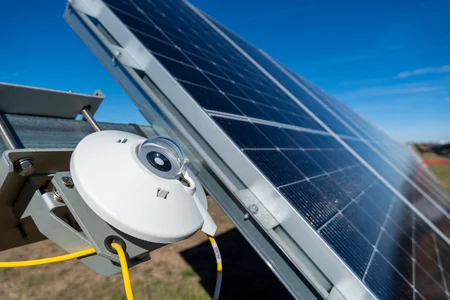
Pyranometers: ISO 9060 Classes, Calibration and Maintenance
A passive pyranometer gives a signal of around 10 millivolts on a bright sunny day. Resolving 1 W/m² of irradiance means resolving 10 microvolts. The sensitivity that converts that signal into irradiance can also change over time, by up to 0.5% per year in higher performance models.
That is why the class of the instrument, the type of output and the calibration interval all matter. This post covers how pyranometers are classified under ISO 9060:2018, how the Kipp & Zonen CMP models map to those classes, and how calibration and maintenance work.
What a Pyranometer Measures
A pyranometer measures irradiance, in W/m², from the hemisphere above a plane surface, integrated over at least 300 to 3000 nm.
Mounted horizontally, it measures global horizontal irradiance (GHI), which combines diffuse horizontal irradiance (DHI) from the sky and direct normal irradiance (DNI) from the sun. Shaded from direct sun, it measures DHI. DNI is measured by a pyrheliometer on a sun tracker. Tilted in the plane of array (POA) of a PV system, it provides the input for performance ratio and efficiency calculations.
ISO 9060 Pyranometer Classes
ISO 9060, Solar energy: Specification and classification of instruments for measuring hemispherical solar and direct solar radiation, was updated in November 2018. It replaced Secondary Standard, First Class and Second Class with three classes, A, B and C. Class A is the most accurate, followed by B and then C.
The 2018 edition describes these as roughly corresponding to the 1990 classes, but the performance parameters and test requirements differ.
Instruments are further described as spectrally flat or fast response. A spectrally flat instrument has a black absorber that needs no post-processing to give good results under different sky conditions. The criterion is a spectral selectivity below 3% (with 2% guard bands) over 350 to 1500 nm. Photodiode radiometers such as the SP Lite2 can be classified (Class C), but are not spectrally flat.
The 2018 edition includes temperature response and directional response in the classification. For Class A, each instrument must be individually tested and reported for both.
The Kipp & Zonen CMP Series by Class
All Kipp & Zonen pyranometers comply with ISO 9060:2018. Kipp & Zonen’s recommended applications for the CMP models are:
- CMP3 (spectrally flat Class C): routine measurements in weather stations and field testing
- CMP6 (spectrally flat Class B): good quality measurements for hydrology networks and greenhouse climate control
- CMP10x (spectrally flat Class A): meteorological networks, PV panel and thermal collector testing, and materials testing
- CMP22 (spectrally flat Class A): scientific research requiring the highest level of accuracy
CMP or SMP: Analogue or Digital
CMP (passive): requires no power, which suits remote sites. The millivolt output means a data logger accuracy better than 10 µV is needed to resolve 1 W/m². This normally means a specialised meteorological logger. Industrial analogue inputs usually do not have enough sensitivity, and the SMP series should be used instead.
SMP (smart): based on the CMP series, with a microprocessor, memory and firmware.
- Modbus RTU over RS-485, with up to 247 addressable units on one network
- Data updated every second
- 5 to 30 VDC supply (10 to 30 VDC for the SMP12)
- Digital temperature compensation from −40 °C to +70 °C
- Faster response than the equivalent CMP, such as an SMP10x at under 2 s (95%) and the fast response SMP12 at under 0.5 s (95%)
Calibration
A pyranometer’s sensitivity is determined under the conditions stated on its calibration certificate and is valid at the date of first use. Exposure to sunlight can cause slight changes in sensitivity over time.
Interval: Kipp & Zonen recommends recalibration at least every two years. Higher performance pyranometers can drift in sensitivity by up to 0.5% per year, and after two years this could significantly affect measurement accuracy.
Method: ISO 9847 covers calibration by comparison with a reference pyranometer, either outdoors or indoors. An outdoor calibration needs two to three days of clear skies, so field pyranometers are normally calibrated indoors. Kipp & Zonen calibrates indoors under a lamp that approximates the solar spectrum, against a working standard calibrated at the World Radiation Centre in Davos. Its instruments are traceable to the World Radiometric Reference, and it has been ISO/IEC 17025 accredited since January 2020.
Continuity: SMP smart pyranometers can be used immediately after recalibration.
Maintenance
- Desiccant: the CMP3, CMP10x and all SMP models have internal desiccant that lasts at least 10 years. Other CMP models have a self-indicating drying cartridge, which should be inspected monthly and the desiccant changed when necessary.
- Dome condition: scratches or chips on the part of the dome that direct sunlight passes through affect measurements. For DHI measurements, where the sensor is shaded from direct sun, most small scratches do not significantly affect readings.
- Ventilation: the CVF4 ventilation unit (IP68) fits all CMP and SMP pyranometers, though it is slightly less effective on the CMP3 and SMP3 because of their smaller dome. It keeps the dome clean of soiling, evaporates dew and raindrops, and reduces infrared thermal offsets. Its heating function melts frost and snow. Ventilation reduces the frequency of cleaning.
ISO 9060 and PV Monitoring
ISO 9060 classifies the instrument. IEC 61724 covers PV system performance monitoring and has its own Class A, B and C for monitoring. An ISO 9060:2018 Class A pyranometer does not necessarily meet the Class A monitoring requirements of IEC 61724, and there are other implications, such as maintenance costs.
Key Points
- ISO 9060:2018 classifies pyranometers as Class A, B or C, with Class A the most accurate.
- Class A instruments are individually tested and reported for temperature response and directional response.
- CMP pyranometers are passive and output a millivolt signal. SMP pyranometers are digital and use Modbus RTU over RS-485.
- Kipp & Zonen recommends recalibration at least every two years.
- An ISO 9060 Class A pyranometer does not necessarily meet the IEC 61724 Class A monitoring requirements.
Related reading: Solar Radiation Monitoring at Aconcagua and Weather Monitoring with the WS601 Smart Weather Sensor