


Industrial FOG Management: Improving Wastewater Performance Through Continuous Grease Removal
Industrial wastewater often contains more than suspended solids and dissolved contaminants. In many industries, including food processing, abattoirs, dairies and commercial kitchens, wastewater also contains significant quantities of fats, oils and grease (FOG). Without effective Industrial FOG management, FOG can reduce the efficiency of wastewater treatment processes, increase maintenance requirements and contribute to blockages within pumps, pipelines and sewer infrastructure. As wastewater treatment systems become more sophisticated and trade effluent standards more stringent, effective FOG management has become an important part of overall plant performance.
While conventional grease traps remain widely used, many facilities are now incorporating continuous grease removal technologies to improve operational reliability and reduce maintenance.
Understanding Fats, Oils and Grease
FOG is generated whenever animal fats, vegetable oils or petroleum-based oils enter a wastewater stream through manufacturing, cleaning or food preparation processes.
Within wastewater, FOG does not always behave in the same way. Depending on temperature, turbulence and the presence of detergents or surfactants, it may occur as:
- Free-floating grease, which naturally rises to the surface.
- Dispersed oil droplets, which may separate over time.
- Emulsified oils, which remain suspended within the water and generally require additional treatment processes to remove.
Mechanical skimming systems are most effective where free-floating FOG is present, making an understanding of wastewater characteristics an important part of selecting an appropriate treatment solution.
Why FOG Creates Operational Problems
Free-floating grease gradually accumulates wherever wastewater flow slows, including balancing tanks, separators, pump stations and pipelines. As these layers increase, they can restrict flow, foul mechanical equipment and interfere with downstream treatment processes.
Common operational challenges include:
- Blocked pipelines and sewer lines
- Pump fouling and increased maintenance
- Surface scum accumulation
- Reduced hydraulic capacity
- Increased odours
- Increased organic loading on downstream treatment processes
- Difficulties meeting municipal trade effluent requirements
Although these issues often develop gradually, they can eventually lead to unplanned maintenance, equipment failures and increased operating costs.
The Role of Grease Traps
Grease traps continue to provide an effective first stage of FOG separation by allowing lighter materials to rise naturally to the surface while cleaner water exits the system.
Their effectiveness, however, depends on several factors, including hydraulic retention time, wastewater temperature, flow conditions and routine maintenance. If grease accumulates faster than it can be removed, or if wastewater bypasses the separation process, FOG may continue into downstream infrastructure where further problems can develop.
For facilities generating high volumes of grease-rich wastewater, additional continuous removal systems can complement conventional grease traps by removing floating grease before excessive accumulation occurs.
Continuous Grease Removal
Rather than relying solely on periodic manual cleaning, continuous grease removal systems operate throughout the day, removing free-floating FOG as it accumulates.
By continuously removing floating grease from the wastewater surface, these systems help limit build-up within tanks while reducing the quantity of FOG entering downstream treatment processes.
Removing grease at this stage can:
- Reduce maintenance frequency
- Improve pump reliability
- Reduce organic loading on downstream treatment processes
- Improve the consistency of wastewater treatment operations
- Reduce cleaning requirements
- Support compliance with trade effluent discharge requirements
The objective is not simply to remove grease, but to improve the overall performance and reliability of the wastewater treatment system.
The Greasebuster®
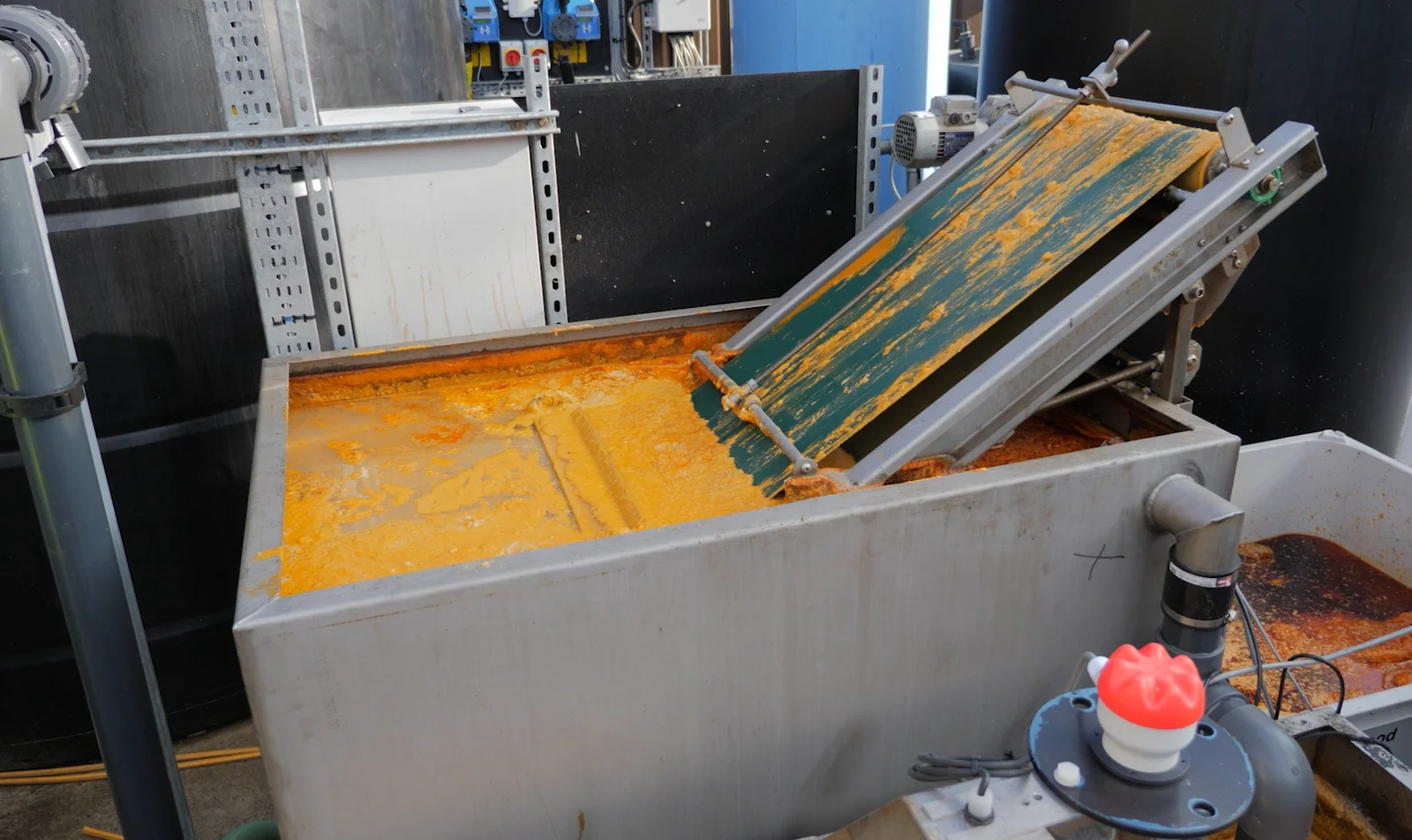
One example of this technology is the Greasebuster®, which uses a continuously rotating hydrophobic belt to remove free-floating fats, oils and grease from the wastewater surface.
As the belt passes through the wastewater, free-floating oils and grease adhere to its surface while water is largely rejected. The collected material is then mechanically scraped from the belt and discharged into a collection container for disposal or recycling.
Because the process operates continuously, grease is removed before significant surface accumulations develop, reducing the amount of floating FOG entering downstream infrastructure.
Like other mechanical skimming technologies, belt skimmers are intended for the removal of free-floating FOG. Wastewaters containing stable emulsified oils may require additional treatment processes such as dissolved air flotation (DAF), chemical conditioning or biological treatment.
Typical Applications
Continuous grease removal systems are widely used in industries where free-floating FOG is generated as part of normal operations, including:
- Food processing plants
- Meat and poultry processing facilities
- Abattoirs
- Dairies
- Breweries and beverage manufacturers
- Fish processing plants
- Commercial kitchens
- Rendering plants
- Edible oil production facilities
- Municipal wastewater treatment works
- Industrial wastewater treatment plants
- Oil-water separator applications
Many systems can be installed within existing tanks or integrated into new wastewater treatment infrastructure with relatively little modification.
Looking Beyond Grease Removal
FOG removal is only one component of effective wastewater management. Understanding how a treatment system performs over time requires reliable monitoring of hydraulic and water quality conditions throughout the process.
Flow measurement, level monitoring, pH, conductivity, dissolved oxygen, turbidity and telemetry all provide valuable operational information that supports process optimisation, preventative maintenance and long-term compliance.
When treatment equipment and monitoring systems are considered together, operators gain a more complete understanding of plant performance and are better positioned to identify operational issues before they become costly failures.
As part of its wastewater solutions portfolio, SME Monitoring supplies the Greasebuster® alongside a range of instrumentation and monitoring technologies for industrial and municipal wastewater applications.