


Transmissivity from Airlift Development: Hydraulic Parameters from New Monitoring Wells
Every new monitoring well goes through the same clean-out step after drilling. Debris and drilling fluids that fall into the hole during drilling have to be removed before the well can be used.
Adrian Lechel, a hydrogeologist with SRK Consulting in Perth, Australia, realised that this routine step could do double duty.
By adding a simple flow measurement and a pressure logger to the clean-out, he developed a method for measuring transmissivity and hydraulic conductivity that is virtually free, gives results quickly, and compares well with pumping tests.
The work, featured in a recent In-Situ customer story, used the In-Situ Rugged TROLL 100 Data Logger.
The Challenge
The hydraulic properties of a site being considered for construction, mining or other excavations are important. They can make or break the decision to proceed.
Transmissivity and hydraulic conductivity determine how quickly or slowly water moves through an aquifer. Hydrogeologists rely on them to predict:
- Production rates
- Dewatering requirements
- Environmental impact
Getting this information takes time and can be extremely expensive. It usually involves drilling additional production wells and conducting pumping tests.
Lechel knew that a faster and easier way of measuring these parameters would be a game changer.
What Is Airlift Development?
Airlift development is the routine clean-out carried out on new monitoring wells.
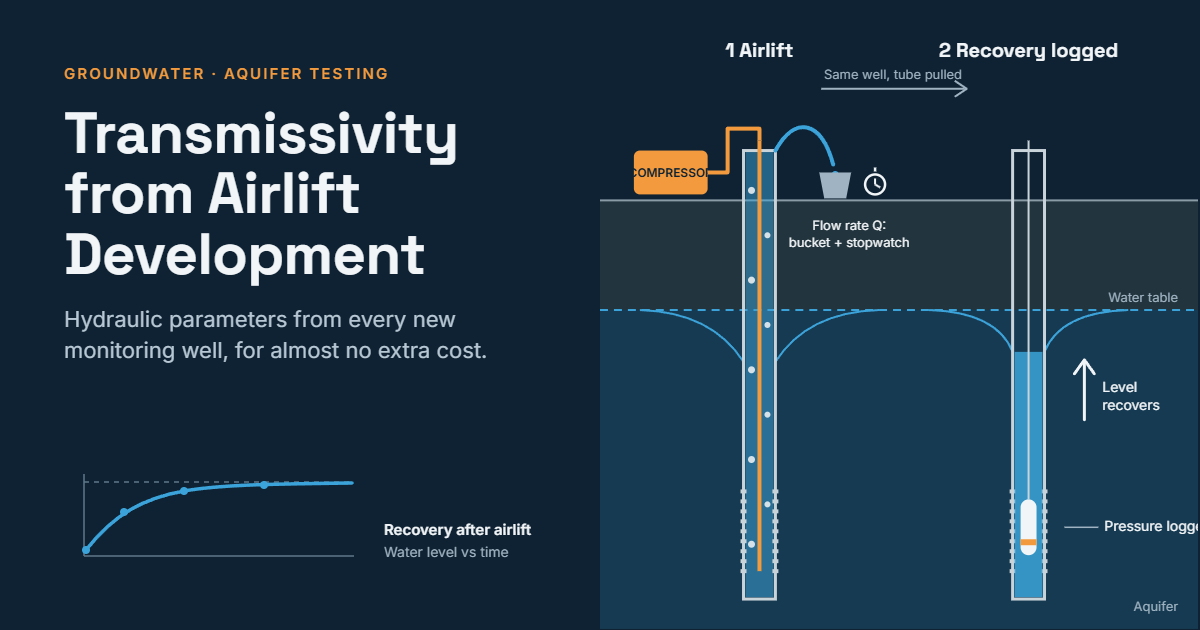
A long tube is lowered into the well and a compressor pushes air down it. The air causes the water to gush upward and spill out of the well, bringing debris and drilling fluid with it.
Lechel compares it to blowing into a straw in a long water bottle: the water comes up and over the sides.
The process usually takes a couple of hours. Electrical conductivity, temperature and pH are measured during development. These readings tell the hydrogeologist when flushing is complete and the water coming out is clean groundwater.
Turning a Clean-Out into a Hydraulic Test
Lechel recognised that airlift development does more than flush the well.
Removing water from the well creates a disequilibrium in the aquifer, in the same way as a slug test or a pumping test.
If the well is already being pumped to clean it, the response of the water level to that pumping can also be measured. The well does not know whether it is being pumped for a pumping test or for cleaning.
The Method
The method combines some low-tech and some high-tech equipment.
Flow rate
The flow rate during the airlift is measured with a bucket and a stopwatch.
Recovery measurement
At the end of the airlift:
- The compressor is stopped
- The tube is pulled from the well
- A Rugged TROLL 100 Data Logger is inserted into the well
- Pressure is recorded for about 20 to 30 minutes as the water recovers from the airlift stress
Calculation
Using the flow rate and recovery data, hydraulic equations are applied to calculate the transmissivity and hydraulic conductivity of the screened aquifer.
Lechel collected airlift development data from every new monitoring well on the mine sites he was working on, about 30 wells in total.
Method Details from the SRK Presentation
SRK’s presentation, Transmissivity from Airlift Development of New Monitoring Bores, gives more detail on the field procedure and analysis.
Field procedure
- Airlift development runs for about 2 to 4 hours.
- The compressor typically runs for about 20 minutes before it is switched off.
- Discharge (Q) is measured with a bucket or a V-notch weir.
- The water level logger is inserted within 15 minutes after the compressor is switched off.
- Residual drawdown is recorded with the logger as the water level recovers.
Analysis
The calculations are based on the Theis (1935) equation, using the residual drawdown during recovery after the compressor is switched off.
According to SRK, neither the maximum drawdown nor the static water level is required for the analysis. This is a practical advantage for airlift development, where these values are not easily measured.
Longer recordings
SRK notes that longer recordings, from several hours up to days until the static water level has recovered, may show diagnostic curves affected by boundary conditions.
Proving the Method
To prove the new method, Lechel needed to compare his results with pumping tests, which he describes as the “gold standard of hydraulic methods”.
That required production wells to be drilled next to the monitoring wells. Because large production wells are expensive, only a small number would be drilled, and the decision on where to drill them had not yet been made.
Several months later, six production wells were drilled next to monitoring wells for which airlift results were already available.
The results:
- Most of the time, the airlift method accurately predicted the pumping test results.
- In further comparisons, the airlift method outperformed slug tests.
Until this work, the slug test had been the only hydraulic testing method for a single monitoring well that could be carried out without an adjacent production well.
SRK’s presentation documents the comparison at three monitoring bores where pumping tests were subsequently carried out at the same locations. According to SRK, the differences between the airlift and pumping test results appeared only at the decimal level.
The airlift results also outperformed falling head (slug) tests carried out at the same bores.
Why It Works
The success of the method makes sense when the fundamentals are considered.
Pumping tests, slug tests and the airlift method all measure the same thing: the recovery of the water level after a disturbance.
The airlift is a disturbance that already happens during the construction of every new monitoring well. Recording the recovery after it allows the hydraulic parameters to be determined more reliably than with slug tests, and without the delay and expense of pumping tests.
More Data Points Across a Site
Because the airlift method is so inexpensive, hydraulic data can be obtained from every new monitoring well drilled on a site.
This increases the number of data points and gives the hydrogeologist a better understanding of the heterogeneity of the aquifer across the project area.
As Lechel points out, that coverage is often more important than the higher quality of transmissivity data from pumping tests carried out at only a few locations.
Limitations and Recommendations
SRK’s presentation is clear about the current limitations of the method.
Limitations
- The documented case study includes only three bores, so additional pumping test data are needed before statistically significant conclusions can be drawn.
- The stated scope of the method is low-yielding monitoring bores where pumping tests are not feasible.
- Application to air-core, reverse circulation (RC) and rotary air blast (RAB) holes is suggested as possible, but has not yet been demonstrated.
Recommendations
- Use airlift development on every new monitoring bore to obtain unbiased hydraulic data and better characterise spatial heterogeneity. SRK notes that this adds no drilling cost and gives immediate results.
- Test the approach on additional bores with pumping tests.
- Extend logger recordings towards static water level recovery to look for boundary condition effects.
Conclusion
Adrian Lechel’s work at SRK Consulting shows how a routine step in monitoring well construction can be used to obtain hydraulic parameters.
By measuring the airlift flow rate with a bucket and stopwatch and recording the recovery with a Rugged TROLL 100 Data Logger, transmissivity and hydraulic conductivity can be determined for every new monitoring well at almost no additional cost.
In comparisons with pumping tests at six production wells, the method most of the time accurately predicted the pumping test results, and it outperformed slug tests.
The result is faster answers, more data points across a site, and a better understanding of how groundwater moves through the aquifer.
SME Monitoring supplies In-Situ water level loggers, including the Rugged TROLL 100, for groundwater monitoring applications.
Further Reading
In-Situ: A New Method to Get Instant Hydraulic Parameters from New Monitoring Wells—For (Almost) Free The original customer story describing Adrian Lechel’s method and results.
SRK Consulting: Transmissivity from Airlift Development of New Monitoring Bores SRK’s presentation of the method, field procedure and comparison results.