


Continuous Water Monitoring Helps Community Solve a Mystery—and Save an Estuary at Risk
Overview
Community concern and science came together to understand the factors causing the decline of the Great Brak Estuary in South Africa in recent years. Drought was causing the estuary connection to the ocean to dry up more frequently, and releases of water upstream from a dam were being done to try to reopen the mouth of the estuary. But the estuary decline persisted.
Continuous monitoring with the Aqua TROLL 600 Multiparameter Sonde was pivotal in revealing an unexpected direct correlation between the upstream releases of water from the dam, with depletion of dissolved oxygen downstream. A new estuary management approach has resulted from the study, which was a partnership between Anchor Environmental and the community nonprofit, the Southern Estuarine Rehabilitation Action Group.
Challenge
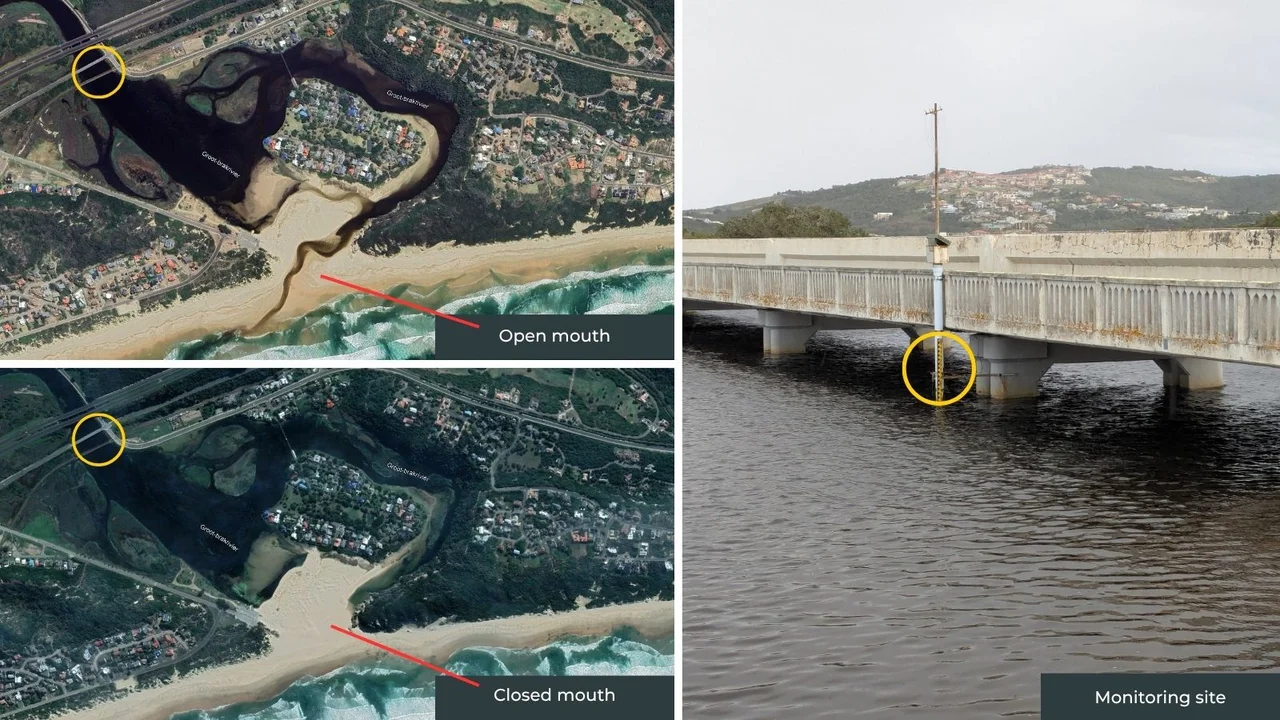
The Great Brak Estuary is an ecologically significant and highly diverse estuary in the Western Cape of South Africa, important not only for its ecological value but also for its use by residents and as a destination for recreationalists and vacationers. The freshwater Great Brak River meets the open ocean at the mouth of the estuary, which is dynamic and alternates between closed and open depending on river flow and coastal conditions. These fluctuations influence the exchange of water and the resulting water quality and health of the estuary.
During the last few decades, that exchange of water has been altered significantly by the construction in 1990 of the Wolwedans Dam on the Great Brak River, about 9 kilometers upstream from the estuary. Releases of water from the dam are allotted each year to maintain the base streamflow and functioning of the estuary. However, recently the water releases have not always occurred because of drought conditions and increasing demand for freshwater for residential and agricultural use.
As a result, the mouth of the Great Brak Estuary has been closed more than in the past, cutting off the estuary’s connection to the ocean. This traps the water in the estuary and prevents normal cycles of flushing with ocean water that bring in oxygen, nutrients, and aquatic life such as fish.
Residents noted the deteriorating conditions in the estuary. Fish and bird populations were declining, and algal blooms were occurring.
“The community was concerned and needed answers,” said Kevin Schmidt of Anchor Environmental Consultants.
“Local residents came together and said, we care about this estuary so much that we want to come together, raise funds, and invest in technology that is going to help us understand the water quality of the environment that we live in.”
In early 2021 the community organized a nonprofit, the Southern Estuarine Rehabilitation Action Group (SERAG), and raised funds to gather more in-depth scientific information about what was occurring.
Solution
This is when SERAG brought Anchor Environmental and Schmidt into the picture. Schmidt knew that continuous monitoring data on the water quality in the estuary was needed to determine what was happening.
“The community had studies that were instantaneous snapshots, once in the dry season, once in the wet season. Those snapshots are not actually representative of the variability over time. And you would never pick up on correlations with activities, such as releases from the dam, without having a continuous time series.”
Schmidt advised SERAG on the data that would provide insight into the estuary’s decline, the monitoring equipment that could provide the data, and how he would set up continuous monitoring. The group mobilized the community and the funding to make it happen, and a partnership between SERAG and Anchor Environmental began that continues to the present.
Schmidt chose the In-Situ Aqua TROLL 600 Multiparameter Sonde and selected a monitoring site on a bridge near the estuary and about 6 kilometers downstream of the Wolwedans Dam.
In late September of 2021, a few months after the SERAG group had formed, the monitoring of conductivity, dissolved oxygen, and temperature began. Measurements are still being made, with chlorophyll added in 2023.
“The Aqua TROLL installed in the Great Brak Estuary has been an ongoing project for about five years now,” said Schmidt.
“It was brought about by the community’s concern for the quality of the water of the estuary, which has dropped significantly. This is a collective effort on behalf of the community, and I am trying to paint the picture.”
Results
It wasn’t long before that picture began to emerge. Schmidt’s monitoring data revealed a puzzling effect — the releases of water from the dam were triggering episodes of low dissolved oxygen and making things worse instead of better.
“We studied that in great depth because we were trying to understand why,” said Schmidt.
“Why is the quality of the water plummeting and it’s actually coinciding with the release of water from the dam?”
The answer circles back once again to the drought conditions. The water level behind the dam was too low for the water to spill over the top of the dam. Instead, the releases were occurring from the bottom, through a sluicegate.
For Schmidt, this explained why the releases were triggering low dissolved oxygen events.
“It’s a massive dam wall, 60 to 70 meters tall. That’s about as tall as a 20-story building. And what we’re suspecting is that the water is stagnant at the bottom where the water is actually being released, at the sluicegate. So the dam operators are actually releasing anoxic bottom water that is high in tannin content and particulates that have settled at the bottom of the dam.”
In other words, the attempts to flush the estuary were instead flooding the estuary with anoxic, toxic water. Clearly a different approach was needed to restore the estuary.
The SERAG community nonprofit has worked cooperatively with the local water authorities to share the findings from the monitoring work. As a consequence, efforts to help the estuary are now focused more on keeping the mouth of the estuary open by excavating the sandbar using heavy equipment.
A new Estuary Management and Maintenance Plan has recently been developed as the operational framework for the Great Brak. Thanks to the partnership of SERAG and Anchor Environmental, it is now science-based.
The Plan includes:
- Trigger levels for breaching (excavating) the mouth
- Sediment management protocols
- Structured, continuous water monitoring
- Monitoring of salinity, dissolved oxygen, temperature and chlorophyll
The plan is nearing approval in February 2026 and has the enthusiastic support of the public as well as the local authorities responsible for implementing it.
Schmidt has greatly enjoyed his interaction with the community, and he loves the estuary and seeing his scientific work put to such good use.
“What I’m learning is that continuous monitoring is really important in so many different settings. And having a sonde that can do several measurements is also helpful. The Aqua TROLL has been an absolute wonder.”
Local universities, government agencies, and regulatory agencies have taken notice. With nearly 300 estuaries in South Africa, the work of SERAG and Anchor Environmental can serve as a model for healthy outcomes in other stressed estuaries.
Chris Ennis