



Designing a Technically Defensible Groundwater Monitoring System
Groundwater monitoring is often approached as an instrumentation exercise. In reality, it is an exercise in applied hydrogeology, measurement science, and data governance.
A Technically Defensible Groundwater Monitoring system means that your measurements:
-
Are traceable to physical principles
-
Quantify and communicate uncertainty
-
Control geometric reference points
-
Correct environmental influences
-
Preserve raw and processed data integrity
Defensibility is not about collecting data. It is about being able to justify it under scrutiny.
Modern integrated monitoring ecosystems such as those developed by In-Situ Inc. make defensibility easier to achieve, but instrumentation alone does not create it. Design discipline does.
1. Hydrostatic Fundamentals: From Pressure to Hydraulic Head
Submersible pressure transducers measure pressure. Hydrogeologists interpret hydraulic head.
The hydrostatic relationship is:

Where:
= measured pressure
ρ = fluid density
= gravitational acceleration
= pressure head
In practice:

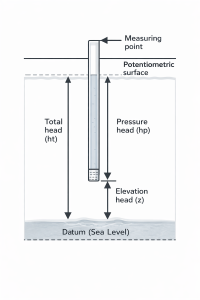
A transducer installed below the water surface measures total pressure. To obtain water level, atmospheric pressure must be removed.
Hydraulic interpretation requires total head (H):
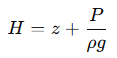
Where:
= elevation head relative to a defined datum
A precise pressure measurement without a surveyed elevation reference does not produce defensible hydraulic head.
Variable Density Considerations
In many field applications, density is assumed constant at approximately 1,000 kg/m³. However, in variable-density environments such as coastal aquifers, saltwater interfaces, or mining-impacted systems, ρ\rho is not constant.
If density changes but data processing software assumes 1,000 kg/m³, calculated hydraulic head will be mathematically incorrect. In such environments, defensibility requires:
-
Documenting assumed density
-
Measuring conductivity where appropriate
-
Evaluating density correction where gradients are small or salinity is significant
Ignoring density is sometimes acceptable. Failing to acknowledge the assumption is not.
2. Sensor Architecture: Vented vs Non-Vented
Selecting a pressure sensor is a risk decision, not a convenience decision.
Vented (Gauge) Pressure Transducers
-
Compensate atmospheric pressure via vent tube
-
Simplify post-processing
-
Require desiccant maintenance to prevent moisture ingress
Vented systems remain technically defensible provided desiccant replacement intervals are documented and logged within QA/QC procedures.
Non-Vented (Absolute) Pressure Transducers
-
Measure total pressure
-
Require barometric correction
-
Mechanically robust in high-condensation or remote installations
Absolute systems paired with a barometric logger are often preferred for deep or remote sites where vent tube integrity cannot be guaranteed.
Field Comparison
| Feature | Vented (Gauge) | Non-Vented (Absolute) |
|---|---|---|
| Atmospheric Compensation | Internal via vent tube | Requires barologger |
| Maintenance | Desiccant management required | Minimal |
| Post-Processing | Simplified | Barometric correction required |
| Risk Factors | Moisture blockage | Compensation error if baro misaligned |
| Best Suited For | Accessible sites with routine maintenance | Remote, deep, or high-condensation sites |
The defensible choice depends on environmental exposure, maintenance access, and monitoring duration.
3. Accuracy, Resolution, and Drift
Manufacturer specifications must be interpreted in hydrogeologic context.
For example:
A ±0.1% full-scale sensor in a 30 m well introduces ±3 cm potential uncertainty.
In low-gradient systems, that uncertainty may materially influence interpreted flow direction.
Hydrogeologists should evaluate:
-
Full-scale accuracy
-
Long-term drift specification
-
Temperature compensation range
-
Stability over deployment interval
-
Sensor response time
Modern digital submersible sensors with stable long-term drift characteristics reduce cumulative error. However, verification through periodic manual checks remains essential.
4. Installation Geometry: The Hidden Source of Error
Precision electronics cannot compensate for imprecise reference control.
A technically defensible installation requires:
-
Surveyed top-of-casing elevation
-
Clearly defined measuring point
-
Fixed sensor depth relative to datum
-
Cable strain relief and stretch control
-
Protection from pump-induced exposure
Cable Stretch in Deep Wells
In deep installations, cable elongation under load can introduce measurable vertical error. Kevlar-reinforced cables are often necessary in deeper wells to minimize stretch and preserve geometric integrity over time.
If reference elevation is uncertain by 5 cm, that uncertainty propagates into every hydraulic head value derived from that well.
Defensibility begins with geometry.
5. Barometric Compensation Strategy
For absolute sensors, barometric correction must be systematic:
-
Barologger located within comparable atmospheric regime
-
Synchronized logging intervals
-
Timestamp alignment
-
Validation during rapid pressure transients
Uncompensated atmospheric fluctuations of 20 mbar can produce apparent water level shifts of approximately 20 cm.
Modern data platforms may automate compensation, but defensibility requires retention of:
-
Raw pressure data
-
Barometric data
-
Compensated level calculations
Transparency enables auditability.
6. Integrating Hydrochemical Context
Water level defines hydraulic conditions.
Water quality defines process.
Integrating parameters such as:
-
Electrical conductivity
-
Temperature
-
Dissolved oxygen
-
pH
allows interpretation of:
-
Recharge events
-
Salinity migration
-
Density-driven flow
-
Early contaminant migration
Multi-parameter sondes with integrated pressure sensors provide co-located datasets. When integrated with telemetry and centralized data platforms, hydraulic and chemical trends can be evaluated together rather than in isolation.
In density-variable environments, this integration becomes essential for correct head interpretation.
7. Telemetry, Redundancy, and Data Integrity
Remote monitoring reduces field visits but introduces digital vulnerabilities:
-
Packet loss
-
Power interruption
-
Clock drift
-
Firmware inconsistencies
A defensible telemetry architecture includes:
-
Local onboard data logging redundancy
-
Timestamp synchronization protocols
-
Alarm threshold validation
-
Controlled data access
Store-and-Forward Capability
Professional instrumentation platforms employ store-and-forward architecture. If the cellular network fails, measurements are not lost. They are stored locally and transmitted once connectivity is restored.
This distinction separates consumer IoT devices from professional environmental monitoring systems. Data delay is manageable. Data loss is not.
Integrated systems that unify submersible sensors, telemetry hardware, and centralized cloud data management reduce fragmentation while preserving raw and processed datasets for audit transparency.
Visibility improves responsiveness. Redundancy preserves defensibility.
8. QA/QC Protocols
No monitoring program is defensible without documented QA/QC.
Recommended practices include:
-
Scheduled manual dip meter verification
-
Drift evaluation against baseline
-
Calibration interval documentation
-
Outlier analysis procedures
-
Data gap review
-
Comprehensive metadata archiving
Cloud-based systems can streamline documentation, but hydrogeologic interpretation remains a professional responsibility.
Monitoring is a scientific process, not a passive data stream.
Conclusion: The Stakes of Precision
A technically defensible groundwater monitoring system:
-
Respects hydrostatic principles
-
Defines total hydraulic head correctly
-
Controls geometric reference
-
Corrects atmospheric and density effects
-
Quantifies uncertainty
-
Preserves raw and processed datasets
-
Implements structured QA/QC
A 20 cm error in hydraulic head may appear minor. In a low-gradient aquifer, it can invert the interpreted direction of groundwater flow. That inversion can alter plume migration models, remediation design, and liability allocation. In regulatory environments, such errors are financial, not academic.
Hydrogeologists are not merely recording water levels. They are producing datasets that influence compliance decisions, remediation costs, and long-term water resource management.
Bottom Line: Instrumentation provides the numbers, but design discipline provides the truth.
Delivering Technically Defensible Groundwater Monitoring in Practice
Designing a technically defensible groundwater monitoring system is one challenge. Implementing and maintaining one over years is another.
At SME Monitoring, our approach is grounded in three principles:
-
Instrumentation must reflect hydrogeologic risk
-
Installation must control geometric and environmental variables
-
Data management must preserve raw and processed integrity
As an instrumentation and monitoring partner, SME Monitoring integrates field-proven submersible pressure sensors, multi-parameter sondes, telemetry hardware, and centralized data management platforms into cohesive groundwater monitoring systems designed for regulatory scrutiny.
Through our partnership with In-Situ Inc., we deploy instrumentation platforms that support:
-
Stable long-term pressure measurement
-
Reliable barometric compensation strategies
-
Integrated water quality monitoring
-
Store-and-forward telemetry architectures
-
Secure cloud-based data archiving
This partnership enables us to deliver groundwater monitoring systems that are not only technically sound at installation, but maintain defensibility throughout the operational life of the monitoring program.
In environments where hydraulic gradients are small, compliance requirements are strict, and decisions carry financial implications, instrumentation reliability and data traceability are not conveniences. They are requirements.
A technically defensible groundwater monitoring system is ultimately a collaboration between hydrogeologic design, disciplined field practice, and robust instrumentation architecture.