


Installing Fully Grouted Vibrating Wire Piezometers
Measuring pore water pressure accurately starts long before the first reading appears on a datalogger. Vibrating wire piezometers may be a highly sensitive instruments, but even the best sensor can produce questionable data if it is poorly installed, inadequately grouted, or positioned at the wrong elevation.
For borehole applications, the installation method is therefore just as important as the instrument itself.
At SME Monitoring, we work with Encardio Rite vibrating wire piezometers for applications where reliable pore pressure and groundwater monitoring are required. This guide explains how to install a vibrating wire piezometer in a borehole using the fully grouted method, based on Encardio’s published installation procedure.
Why Monitor Pore Water Pressure?
Pore water pressure is an important parameter in geotechnical and civil engineering projects.
Changes in groundwater conditions can influence effective stress, slope stability, consolidation, seepage and the behaviour of earth and rock structures. Pore pressure monitoring provides engineers with information that can help identify changes in subsurface conditions before they become a larger problem.
Vibrating wire piezometers are commonly used for monitoring:
- Dams and embankments
- Foundations
- Slopes and landslides
- Deep excavations
- Mines
- Tunnels
- Earth and rockfill structures
- Groundwater conditions
The sensor measures pressure at a defined point underground, allowing changes to be tracked over time.
That makes installation accuracy critical. If the sensor is not properly coupled to the formation, or if different monitoring zones are allowed to communicate through the borehole, the resulting data may not represent the pressure conditions at the intended measurement point.
The Fully Grouted Method for Piezometer Installation
There are several approaches to installing piezometers in boreholes.
A traditional approach may use sand pockets around the sensors with bentonite seals between monitoring zones. While this can work, installing multiple sensors at different depths can become complicated, and inadequate sealing can create unwanted hydraulic communication between zones.
The fully grouted method provides an alternative.
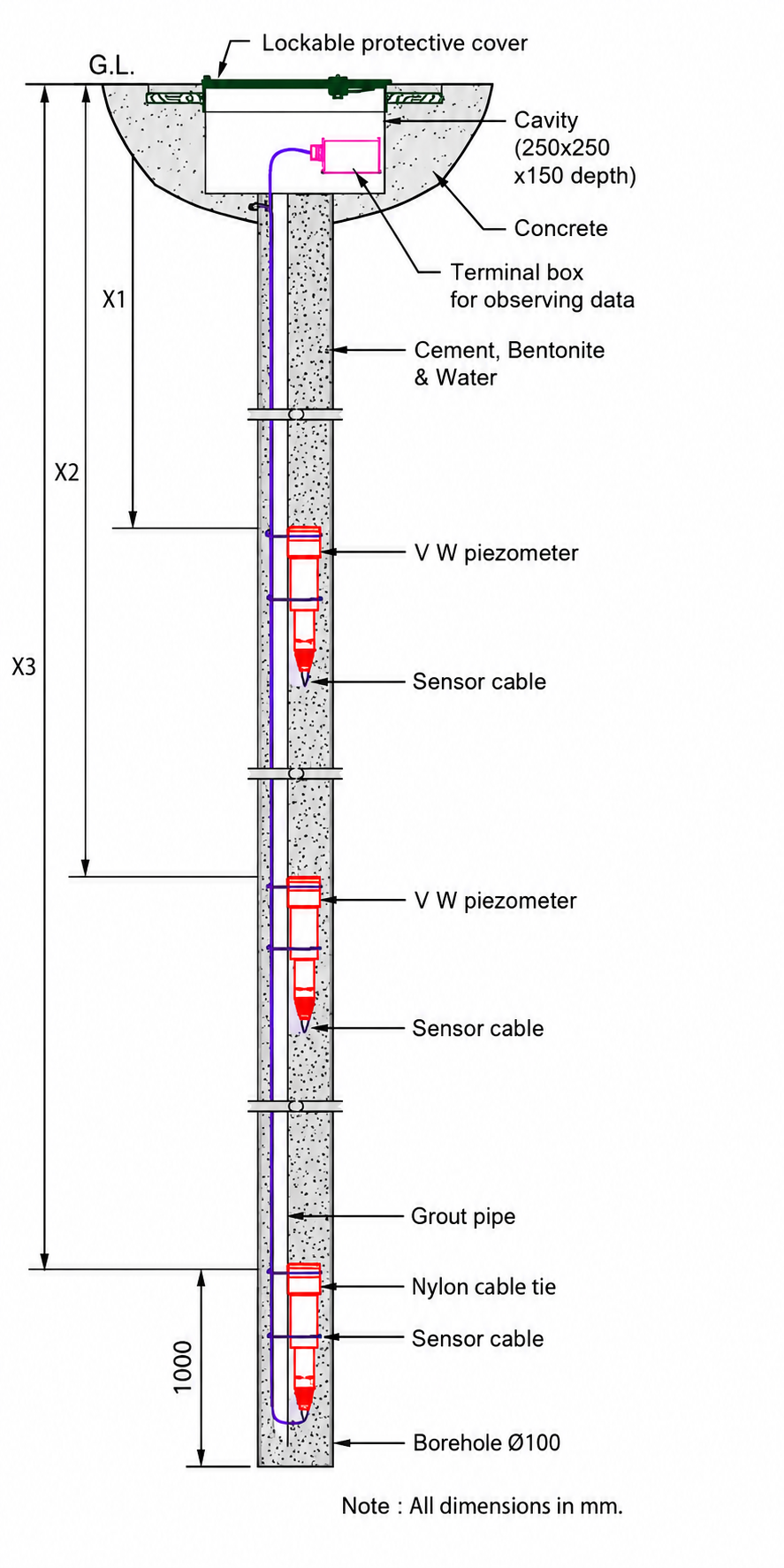
With this approach, the vibrating wire piezometers and associated tubing are lowered into the borehole and the annular space is filled continuously with grout. The grout provides hydraulic coupling between the sensor and surrounding formation while helping to isolate different monitoring zones.
This makes the fully grouted method particularly useful when multiple vibrating wire piezometers are installed at different elevations within the same borehole.
1. Establish the Installation Depths
Before drilling begins, determine the required monitoring elevations.
For a multilevel installation, each vibrating wire piezometer must be positioned at its specified depth. The cable attached to each instrument should be long enough to reach the surface, with additional length allowed for connection and installation.
The elevation of every installed sensor should also be recorded.
This information becomes extremely important later when pressure measurements are compared with groundwater levels, geological conditions or other monitoring data.
2. Prepare the Borehole
The borehole should be drilled to the required depth and diameter according to the project design and the dimensions of the selected piezometer, extending approximately 1 m below the intended piezometer elevation. Casing may be required where borehole stability is a concern.
Once drilling is complete, the borehole needs to be thoroughly cleaned.
Fresh water can be circulated through the borehole to remove drilling debris and loose material before the instrumentation is installed.
A clean, stable borehole gives the installation a much better starting point.
3. Prepare the Vibrating Wire Piezometer
Before the sensor disappears down the hole, this is the time to check that everything is working.
Inspect the piezometer and cable for damage and make sure the sensor has been prepared according to the manufacturer’s requirements.
The sensing element should be properly saturated where required. Removing trapped air from the filter and sensing system is important because the presence of air can affect the response of a pore pressure sensor.
The piezometer is then connected to the readout equipment so that an initial reading can be recorded.
For Encardio installations, the EDI-51V readout unit can be used to obtain the vibrating wire frequency and temperature readings.
It is good practice to record:
- Initial frequency reading
- Sensor temperature
- Installation elevation
- Barometric pressure where relevant
- Sensor identification
- Borehole and installation location
This creates the baseline against which future measurements can be assessed.
4. Assemble the Piezometer and Grout Pipe
The bottom-most piezometer is connected to a sacrificial grout pipe.
The sensor is secured to the pipe using a suitable cable tie, with the sensing tip oriented upwards as specified for the installation.
This arrangement helps protect the sensor and reduces the possibility of de-saturation during installation.
The instrument cable is then secured to the grout pipe at regular intervals.
The objective is simple: get the sensor to its intended depth without allowing the cable or instrument assembly to become tangled, displaced or damaged.
5. Lower the Piezometer Assembly into the Borehole
The assembled piezometer is carefully lowered into the borehole.
For installations containing multiple sensors, each piezometer must be positioned at its specified monitoring elevation.
The grout pipe and instrument cable should be secured at regular intervals as the assembly is lowered.
Care is required at this stage. A sensor that reaches the wrong elevation is not going to become more accurate simply because everyone wishes very hard.
Once the assembly has reached the required depth, another reading should be taken to confirm that the instrument is functioning correctly.
The measured pressure should also be considered against the expected hydraulic conditions, including the water column above the sensor.
6. Grout Mix Ratio for Piezometer Installation
The grout is one of the most important parts of a fully grouted piezometer installation.
It needs to be pumpable enough to reach the required depth while providing appropriate coupling and hydraulic isolation once cured.
Note that the site conditions and engineer should alwas be consulted regarding the the grout mixture. For the specific Encardio installation procedure referenced here, the published reference mixture is:
- 50 kg cement
- 15 kg bentonite
- 125 litres water
The cement is mixed with the water first, followed by the gradual addition of bentonite.
The bentonite should be introduced carefully to avoid creating lumps. The resulting grout should have a smooth, pumpable consistency rather than becoming so thick that it cannot be reliably placed down the borehole.
Important: this is Encardio’s published reference grout mix for its installation procedure, not a universal grout specification for every piezometer installation. The final grout design should be determined by the project requirements, ground conditions and responsible geotechnical or grouting engineer.
7. Grout the Borehole Continuously
Once the piezometer assembly is correctly positioned, grout is pumped through the sacrificial grout pipe.
The grout fills the annular space around the instrumentation and continues until it reaches the surface.
Where casing has been used to maintain borehole stability, it can be progressively withdrawn as grouting proceeds.
Continuous placement is important. Interruptions or inadequate grout volumes can compromise the installation and potentially leave voids around the instrumentation.
The grouting equipment must also have sufficient capacity to deliver grout to the required depth.
8. Allow the Grout to Set
Grouting is not the finish line.
As the grout settles and cures, the installation conditions can change. The borehole should therefore be checked after the initial settling period and topped up where necessary.
We recommend allowing the grout to settle overnight, or for at least 12 hours, before topping it up.
After grouting, the piezometer should be read again.
The measured pressure may initially be higher because the grout column above the sensor is denser than water. As the grout cures, the readings should move towards their normal condition.
Note that grout typically requires at least two days to cure and that readings should normalise as curing progresses.
This is an important reminder not to treat the first post-grouting reading as automatically representative of long-term formation pressure.
9. Protect the Completed Installation
Once the borehole installation is complete, the exposed instrumentation needs to be protected from physical damage and environmental conditions.
Depending on the application, the installation may include a concrete platform and lockable protective cover, with the piezometer cable terminated in a suitable terminal box.
In larger structures such as dams, it may instead be preferable to route a continuous cable from the sensor directly to an observation area.
The protection arrangement should suit the site and the long-term monitoring requirements.
10. Record the Installation and Baseline Data
A good installation should leave behind more than a sensor in a hole.
The final installation records should include the important information needed to interpret the data later.
At minimum, record:
- Borehole location
- Borehole depth
- Piezometer model and serial number
- Sensor elevation
- Cable length
- Initial frequency
- Initial temperature
- Barometric pressure where applicable
- Grout mix and quantities
- Installation date
- Post-installation readings
- Any deviations from the planned installation
The sensor elevation is particularly important.
Pore pressure data without a reliable reference elevation can make interpretation considerably more difficult.
Why Installation Quality Matters
A vibrating wire piezometer is designed to provide highly sensitive measurements, but the sensor does not operate in isolation.
The borehole, grout, surrounding ground, installation elevation and measurement system all form part of the monitoring system.
A poorly installed sensor can therefore create problems that look like changes in ground conditions when they are actually installation effects.
Good installation practice helps ensure that the pressure measured by the instrument represents the pressure at the intended monitoring zone.
That is ultimately what the monitoring system is there to achieve.
Encardio Vibrating Wire Piezometers
Encardio offers a range of vibrating wire piezometers for different monitoring requirements.
The EPP-30V is a heavy-duty vibrating wire piezometer intended for long-term monitoring, while the slimmer EPP-40V can be used where borehole diameter is restricted. Encardio also offers other piezometer configurations for applications including low-pressure groundwater monitoring.
The EDI-51V vibrating wire readout unit can be used to obtain measurements from compatible Encardio vibrating wire instruments during installation and monitoring.
Selecting the correct sensor is only the beginning, however.
The installation method, sensor preparation, baseline readings, grout placement, protection and subsequent data management all contribute to the quality of the final monitoring system.
Reliable Pore Pressure Monitoring Starts Underground
A vibrating wire piezometer can provide valuable information about what is happening beneath a site, but reliable data depend on getting the installation right.
From establishing the correct monitoring elevation to preparing the sensor, positioning the assembly, grouting the borehole and recording the baseline conditions, every stage contributes to the quality of the final measurements.
For projects involving dams, slopes, excavations, foundations, mines or other geotechnical structures, properly installed vibrating wire piezometers can provide a long-term window into changing subsurface conditions.
At SME Monitoring, we can assist with vibrating wire piezometers and geotechnical monitoring solutions for projects where understanding subsurface conditions is critical.
Because when the thing you’re trying to measure is buried several metres underground, there isn’t much room for “close enough.”